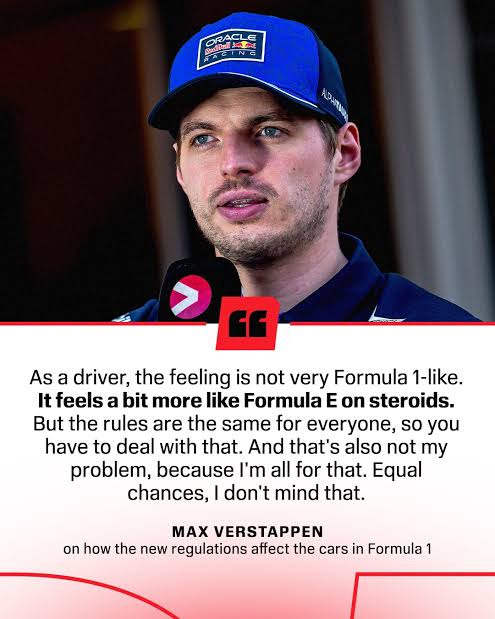
The world of Formula 1 has never been static. From turbocharged monsters of the 1980s to today’s hybrid-powered machines, the sport has constantly evolved in pursuit of innovation, sustainability, and competitive balance. But recent regulatory changes have sparked fresh controversy—this time led by three-time world champion Max Verstappen, who has openly criticized the new direction of the sport.
In an interview with NU.nl, Verstappen did not hold back. Describing the new regulations as “unworthy of Formula 1,” he expressed frustration over what he sees as a shift away from pure racing toward energy management and conservation.
“Formula 1 Should Be About Going as Fast as Possible”
At the heart of Verstappen’s criticism is a fundamental philosophical disagreement. For him, Formula 1 represents the pinnacle of speed, performance, and driver skill. However, he argues that the current regulations force drivers to prioritize energy recovery and battery management over outright pace.
According to Verstappen, drivers now find themselves lifting off the throttle and taking certain corners more slowly—not because of tire degradation or race strategy—but to recharge energy systems. He compared this approach to Formula E, a championship built specifically around electric power and energy-saving tactics.
“Yes, sorry,” Verstappen reportedly said, “but that’s part of Formula E. Formula 1 should be about going as fast as possible.”
His remarks highlight a growing tension within the sport: the balance between technological progress and the essence of racing.
Adapting vs. Enjoying
Importantly, Verstappen made it clear that his criticism is not about his own ability to adapt. “As a driver, I always adapt,” he explained. He emphasized confidence in his own skills and insisted that handling the car is not the issue.
Instead, his concern lies in the driving experience itself. He openly admitted that he does not enjoy driving the current cars under these regulations. For a driver at the peak of his career, that statement carries significant weight. Enjoyment, passion, and instinct are central to elite performance—especially in a sport as physically and mentally demanding as Formula 1.
His blunt tone—“Some people will be unhappy with these statements, but I don’t care. I didn’t make the rules.”—reflects both frustration and authenticity. Verstappen has built a reputation for speaking candidly, even when his opinions challenge governing bodies or team politics.
The Bigger Picture: Sustainability vs. Spectacle
Formula 1’s regulatory direction has been heavily influenced by environmental concerns and sustainability goals. Hybrid power units and energy recovery systems are designed to make the sport more efficient and relevant to future automotive technology.
However, critics argue that too much emphasis on energy management risks diluting the spectacle. Fans tune in to see drivers pushing the limits, braking late, accelerating hard, and extracting every ounce of speed from their machines. When drivers must consciously slow down to recharge systems, it raises questions about whether the sport is drifting away from its core identity.
Verstappen’s comments tap into that broader debate: Should Formula 1 prioritize technological responsibility, or should it remain a pure expression of speed and performance?
A Voice That Carries Weight
As a multiple world champion and one of the sport’s most dominant figures, Verstappen’s words resonate beyond casual commentary. His opinion may influence discussions among teams, drivers, and regulators as the sport continues refining its future regulations.
While some may see his remarks as resistance to change, others interpret them as a call to preserve Formula 1’s DNA. Regardless of perspective, his message is clear: he believes Formula 1 should never compromise its identity as the fastest and most extreme form of circuit racing in the world.
The coming seasons will reveal whether the sport leans further into energy efficiency or recalibrates toward raw speed. For now, Verstappen’s criticism has ignited a conversation that Formula 1 cannot afford to ignore.